CÔNG TY LUẬT ANT

Công ty Luật hàng đầu Việt Nam

CÔNG TY LUẬT ANT

Tư vấn pháp lý cho tổ chức công ty và cá nhân

CÔNG TY LUẬT ANT

Tư vấn pháp luật uy tín

CÔNG TY LUẬT ANT

Đội ngũ luật sư chuyên nghiệp

CÔNG TY LUẬT ANT

Có nhiều kinh nghiệm và chuyên môn cao

Thứ Tư, 16 tháng 4, 2025

7 Essential Insights About Business Incorporation in Vietnam: A Hopeful Guide for Foreign Investors

  In a world increasingly defined by instability, geopolitical tensions, tax wars, protectionist policies, and shifting global supply chains, business still has to go as usual, money flows where opportunities exists, and foreign investors are looking for places that offer stability, opportunity, and legal clarity.

Vietnam, with its sustained economic growth, favorable location in Southeast Asia, and ongoing regulatory reforms, has emerged as one of the region’s most promising business destinations. While its appeal has been steadily rising, the country’s role as a dependable investment hub has never been more relevant than it is now.
7 Essential Insights About Business Incorporation in Vietnam

This article is a brief guide for foreign individuals and companies considering business incorporation in Vietnam. It is designed to demystify the legal and practical framework for setting up a companyopening a bank account, and staying compliant with the country’s legal and financial rules.

With particular focus on limited liability companies and non-conditional investment sectors, this guide outlines the steps, timelines, and requirements involved. Whether you’re looking to establish a consulting firm, expand your tech business, or start something new from the ground up, this is the roadmap you’ll need to move forward with clarity and confidence.

Why Vietnam Stands Out

Vietnam’s success as an investment destination is rooted in its balance of modern development and political steadiness. While many countries face internal unrest or unpredictable regulatory environments, Vietnam remains focused on attracting high-quality foreign investment through long-term planning, investor protection, and trade liberalization.

It maintains membership in numerous bilateral and multilateral free trade agreements—such as the CPTPP, EVFTA, and RCEP—that ensure preferential market access, and more importantly, reinforce its commitment to international norms and investment transparency.

The government’s steady efforts to digitize administrative procedures, simplify licensing, and reform corporate laws have made Vietnam increasingly accessible to foreign entrepreneurs. With a young, dynamic labor force and growing middle class, the domestic market itself is becoming more attractive, while the country’s central position within Asia makes it ideal for companies seeking to access regional supply chains. Business incorporation in Vietnam, while still demanding a degree of legal and procedural precision, is easier today than ever before for investors who take the time to prepare properly.

Choosing the Right Structure: The Case for Limited Liability Companies

Among the different forms of business entities that foreign investors can establish in Vietnam, the limited liability company, or LLC, is the most practical and commonly adopted.

An LLC in Vietnam can be formed with just one member or multiple members, who may be either individuals or organizations. It allows full foreign ownership in many non-conditional sectors and shields the investors from personal liability beyond the capital they contribute.

This model is also simpler to manage than a joint-stock company, which requires a more complex governance structure and is typically reserved for large-scale or public investment. The LLC’s streamlined compliance requirements, straightforward management structure, and adaptability to both small and medium enterprises make it the go-to format for most cases of business incorporation in Vietnam.

Understanding Vietnam’s Investment Classification

Vietnam classifies investment activities into two broad categories: conditional and non-conditional. Conditional investment areas are those that, due to national security, social welfare, or market regulation considerations, require specific government approvals, licenses, or compliance with additional legal conditions.

This guide focuses exclusively on non-conditional investment areas. These are sectors that are open to foreign investment without requiring additional licenses beyond standard incorporation documents. Most common business activities such as IT, consulting, and most services fall under this category and are therefore not subject to the same level of regulatory scrutiny. Nonetheless, it’s important to confirm your intended business scope with legal experts before beginning the process of business incorporation in Vietnam, as the categorization may change depending on the exact nature of your operations and evolving local regulations.

The Incorporation Process in Vietnam: A Step-by-Step Journey

Starting a business in Vietnam requires planning and procedural diligence. The process generally includes five key phases: preparing your documents, applying for the Investment Registration Certificate (IRC), applying for the Enterprise Registration Certificate (ERC), fulfilling post-licensing compliance obligations, and opening a corporate bank account. While none of these stages are prohibitively difficult, missteps can lead to costly delays or rejections.

The first stage involves preparation. Investors must choose a business activity that complies with Vietnamese law and secure an office lease for the company’s registered address. For foreign companies investing in Vietnam, a key requirement is submitting audited financial statements from the most recent fiscal year. These documents must demonstrate the parent company’s financial capacity to support operations in Vietnam. All foreign documents must be notarized, legalized, and consularized before they are accepted by Vietnamese authorities.

Once all documents are properly translated and authenticated, the investor proceeds to apply for the Investment Registration Certificate (IRC). This certificate is required for all foreign-invested companies and must be approved by the competent licensing authority, which used to be the Department of Planning and Investment (DPI), but may vary due to Vietnam’s ongoing administrative restructuring. The processing time for the IRC has expanded in practice, depending on the jurisdiction and the complexity of the investment.

Following the IRC, the investor applies for the Enterprise Registration Certificate (ERC), which serves as the business’s official license under Vietnamese law. The ERC includes key corporate details such as company name, registered address, charter capital, legal representative, and business scope.

Post-incorporation compliance includes registering the business’s tax code, announcing the company formation on the national enterprise registration portal, engraving the company seal, and fulfilling any other administrative steps required by law. Depending on the nature of the business, registration for VAT and other taxes may also be necessary.

Finally, a corporate bank account must be opened. This step is crucial, as capital contributions must be made via bank transfer to the company’s Vietnamese bank account. Depending on the bank, whether local or foreign, account opening may taking more or less time. Banks will require the submission of incorporation documents, information on the company’s ownership and beneficiaries, and compliance with Know Your Customer (KYC) requirements. Planning for potential delays at this stage is advisable when pursuing business incorporation in Vietnam.

What You’ll Need: Documentation and Compliance

Incorporating in Vietnam involves assembling a package of documents that varies slightly depending on whether the investor is an individual or a company. Individual investors must present a valid passport and legal address, while corporate investors must submit a legalized and consularized certificate of incorporation, audited financial statements, and a resolution from the board of directors or parent company authorizing the Vietnam investment.

Other required documents include the company charter, a lease agreement for the company’s office, and a list of founding members. If the investor is using a third-party service provider or representative, a power of attorney will also be necessary.

Once the company is formed, opening a corporate bank account will require submission of the Investment Registration Certificate, Enterprise Registration Certificate, company seal sample, tax code, and signed KYC forms. Proof of identity and residential address of the ultimate beneficial owner (UBO) must also be disclosed, in compliance with Vietnam’s anti-money laundering regulations. Proper documentation is key to a smooth and successful business incorporation in Vietnam.

Citizenship: What Foreign Investors Should Know

Vietnam is generally welcoming to foreign investors, particularly those from countries that are members of the World Trade Organization (WTO). Thanks to Vietnam’s WTO commitments, investors from member countries benefit from greater transparency and access under the most-favored-nation principle.

However, investors from jurisdictions not party to WTO agreements may face additional barriers or review procedures. In some cases, such as when an investor is from a country subject to international sanctions or on an internal watchlist, the licensing authorities may require additional due diligence or deny incorporation outright. Additionally, dual citizens or individuals residing in high-risk financial jurisdictions should anticipate extended review periods and provide comprehensive disclosure of their identity and source of funds.

Corporate investors, especially those with multi-layered ownership structures or ties to offshore jurisdictions, should also be prepared to demonstrate not only legality but transparency. Financial documentation will need to be clear, recent, and auditable, and compliance with international reporting standards may be requested during business incorporation in Vietnam.

AML and KYC: Banking and Compliance Expectations

Vietnam’s financial regulatory system has strengthened significantly over the past decade, particularly in the realm of anti-money laundering (AML) and financial transparency. All companies and financial institutions operating in Vietnam are bound by the country’s Anti-Money Laundering Law and related implementing guidelines.

When opening a corporate bank account, investors must comply with Know Your Customer (KYC) rules, which require banks to verify the company’s ownership, source of investment capital, intended business activities, and identify all parties with control or influence over the business.

Foreign banks in Vietnam tend to apply more stringent KYC protocols in line with global standards. This often results in longer processing times and additional paperwork, particularly for corporate investors.

In contrast, local Vietnamese banks may apply more flexible risk-based assessments. While they still comply with national regulations, their internal procedures tend to focus more on local context and documentation rather than rigid global compliance checklists. As a result, opening accounts at local banks may be faster and more straightforward, especially for investors engaged in business incorporation in Vietnam in low-risk, non-conditional sectors.

Common Mistakes and How to Avoid Them

A common cause of frustration among foreign investors is the assumption that Vietnam’s incorporation process is identical to that of Western countries. In reality, it is unique and requires a clear understanding of procedural nuances. One major mistake is failing to have corporate documents properly legalized and notarized, this is not optional and must be done in accordance with Vietnam’s consular requirements.

Another misstep is choosing a business activity without checking whether it is conditional or restricted. This can result in a rejected license application or the need to restart the entire process under new terms. Investors also frequently underestimate the timeline for bank account opening or expect to contribute capital in cash, which is not permitted. All capital contributions must be made via bank transfer from the investor’s account abroad to the company’s capital account in Vietnam.

Additionally, some investors neglect post-licensing compliance tasks, such as announcing the company formation or registering for tax codes. These are not formalities; failure to complete them may incur penalties or invalidate your registration. Avoiding these mistakes will ensure a smoother experience in business incorporation in Vietnam.

Final Thoughts: Vietnam is Open If You’re Ready

Business incorporation in Vietnam is increasingly accessible for foreign investors.  But, understanding the regulatory framework, preparing compliant documentation, and allowing realistic timeframes for licensing and banking are all critical to success.

Vietnam rewards those who prepare. It offers a stable business environment, a welcoming attitude toward foreign capital, and strong economic fundamentals. Investors who work with experienced professionals, follow the law, and stay up to date on policy changes can expect not only a smooth entry into the market but a strong foundation for growth.

As global uncertainty continues to shape investment decisions, Vietnam offers something rare: predictability, growth, and opportunity wrapped into one jurisdiction. For those willing to engage thoughtfully, it may very well be the most rewarding move you’ll make in the decade ahead.

Frequently Asked Questions (FAQs)

How long does it take to complete business incorporation in Vietnam?

The process of business incorporation in Vietnam typically takes around 4 to 6 weeks for most non-conditional investment sectors. This includes document preparation, licensing, and bank account setup.

What is the timeline for obtaining the Investment Registration Certificate (IRC)?

It usually takes up to 20 working days to obtain the IRC. This timeline may vary slightly depending on the province, the business sector, and the quality of submitted documents.

How long does it take to receive the Enterprise Registration Certificate (ERC)?

After receiving the IRC, the ERC is typically issued within 5 to 7 working days, provided that all required documents are accurate and complete.

What is the expected duration for opening a corporate bank account in Vietnam?

The timeline to open a corporate bank account ranges from 1 to 4 weeks, depending on the bank’s internal compliance process and whether you choose a local or foreign bank. Foreign banks may take longer due to stricter KYC and AML procedures.

Can I speed up the process of business incorporation in Vietnam?

While certain administrative steps are fixed by law, having all documents correctly prepared, properly legalized, and using a knowledgeable local service provider can significantly reduce delays during business incorporation in Vietnam.

Is it possible to begin operations before completing bank account setup?

Yes. After your companies complete all steps of business incorporation in Vietnam, including obtaining the IRC, ERC, your company can operate.  But, opening the corporate bank account would allow your company receiving any revenue from business activity or capital contribution.

Are the timelines the same in every city or province in Vietnam?

Not exactly. Although business incorporation in Vietnam follows a national framework, processing speed may vary between cities due to local administrative differences and staffing.

ANT Lawyers, a Law Firm in Vietnam

We help clients overcome cultural barriers and achieve their strategic and financial outcomes, while ensuring the best interest rate protection, risk mitigation and regulatory compliance. ANT lawyers has lawyers in Ho Chi Minh city, Hanoi,  and Danang, and will help customers in doing business in Vietnam.

Source: https://antlawyers.vn/corporate/business-incorporation-in-vietnam-7.html
Chủ Nhật, 13 tháng 4, 2025

5 Inspiring Reasons Why Vietnam Needs a Strong Vietnam Legal Framework for Digital Assets Today


Global Momentum and Why Vietnam Needs a Legal Framework for Digital Assets

In recent years, the world has witnessed an unprecedented surge in digital assets. From cryptocurrencies like Bitcoin and Ethereum to financial derivatives such as security tokens, and even NFTs in art and entertainment, digital assets are no longer futuristic fantasies. They’ve become a present day force reshaping finance, technology, and innovation.

The concept of digital assets is no longer confined to tech enthusiasts or speculative investors. It has drawn the attention of leading economies, precisely because digital assets are a product of the 4.0 Industrial Revolution, a fusion of blockchain, artificial intelligence, cloud computing, and big data infrastructure. These assets not only symbolize innovation but also unlock new markets for digital services, financial products, and global investment.

Vietnam Legal Framework for Digital Assets

Vietnam Riding the Global Digital Wave

Vietnam has been swept up in this wave of global digital transformation. Despite a lack of formal regulation, the country has seen a boom in underground crypto exchanges, local tech companies experimenting with token issuance, blockchain platforms, and digital asset wallets. On the demand side, an increasing number of young investors are actively participating in digital asset markets, driven by high returns, despite high risks and regulatory uncertainty.

Several studies place Vietnam among the top countries globally in terms of cryptocurrency adoption. Despite the vibrant growth, the Vietnam legal framework for digital assets remains practically nonexistent. Digital asset transactions are neither fully legal nor explicitly banned, putting both investors and regulators in a legal limbo.

The Risks of a Legal Vacuum

Without a Vietnam legal framework for digital assets, risk is inevitable. Investors fall prey to scam projects, fraudulent exchanges, and tokens that vanish in value overnight. The government misses out on taxable revenue from lucrative trades. Law enforcement agencies struggle to handle disputes or crack down on money laundering conducted through blockchain channels. This legal void not only causes financial damage but also undermines market credibility and the country’s digital economy goals.

Global pressures compound the challenge. Many countries have already issued legislation to regulate digital assets. While their approaches vary, they all share one conclusion: delay is not an option.

Vietnam’s Policy Shift Toward Digital Asset Regulation

In light of these trends, the Vietnamese government has made building a Vietnam legal framework for digital assets a policy priority.

  • March 6, 2025: The Office of the Government issued Notice No. 81/TB-VPCP summarizing the Prime Minister’s conclusions during a cabinet meeting on accelerating digital asset regulation.
  • March 9, 2025: The Prime Minister issued Official Dispatch No. 22/CĐ-TTg, calling for streamlined administrative procedures and a pilot mechanism for digital asset issuance and transactions.
  • March 11, 2025: The Ministry of Finance submitted Proposal No. 64/TTr-BTC to the government, outlining a pilot resolution for issuing and trading digital assets. This marks Vietnam’s first formal step toward officially recognizing and managing digital assets, even if it’s just a trial phase.

Legal Framework Matters

Why does Vietnam need a legal framework for digital assets?

Because no market can thrive without rules. Laws are not just tools for control, they’re platforms for transparent, fair, and sustainable growth.

A Vietnam legal framework for digital assets should include legal provisions, technical guidelines, and management policies governing the entire lifecycle of digital assets, from identity, issuance, transaction, storage, and transfer to dispute resolution and user protection.

It draws the line between what’s legal and what’s not. Who can issue tokens? Who can trade them? What taxes apply? How are disputes resolved?

More critically, this framework empowers the state to manage macroeconomic risks and shield the national financial system from technological disruptions. Strategically, it’s a move Vietnam must take to stay competitive in the global digital economy race.

The Vietnam legal framework for digital assets is no longer a “nice-to-have”, it’s a must-have. With global markets moving rapidly, Vietnam has a unique opportunity to take actions responsibly, protect its citizens, and position itself as a forward-looking digital economy. By doing so, Vietnam would join the race in a proactive ways.

About ANT Lawyers, a Law Firm in Vietnam

We help clients overcome cultural barriers and achieve their strategic and financial outcomes, while ensuring the best interest rate protection, risk mitigation and regulatory compliance. ANT lawyers has lawyers in Ho Chi Minh city, Hanoi,  and Danang, and will help customers in doing business in Vietnam.

Source: https://antlawyers.vn/update/vietnam-legal-framework-for-digital-assets.html

Thứ Hai, 7 tháng 4, 2025

7 Reasons to Set Up a Subsidiary in Vietnam Now: A Powerful and Timely Move Amid Global Shifts


The World Is Changing Fast, So Should Your Strategy

When the world becomes unpredictable, the winners are those who adapt first. For foreign businesses facing mounting U.S. tariffs, geopolitical tensions, and inflationary pressures, the question is urgent: Where do we go next? Still, one of the option is to set up a subsidiary in Vietnam.

Vietnam is no longer just “emerging.” It’s surging, with a government committed to economic transformation, a favorable geographic position, and a legal environment evolving rapidly to support foreign investment.

7 Reasons to Set Up a Subsidiary in Vietnam Now

In here, amid new US tariffs annoucement that shock the world, we look into compelling reasons foreign investors still consider to set up a subsidiary in Vietnam now and how to do it right.

Vietnam Offers a Safe Harbor Amid Global Trade Storms

The global trading environment is increasingly volatile. U.S. tariffs on Vietnamese exports and many of US long term trading partners are sending shockwaves through established supply chains. But companies need to adapt quicly.

Vietnam, with its network of free trade agreements (EVFTA, RCEP, CPTPP), allows companies to hedge against protectionist pressures. When you set up a subsidiary in Vietnam, you gain preferential access to many markets while anchoring your operations in a stable, low-cost, business-friendly country.

Regulatory Reforms Are Opening Doors Faster Than Ever

Vietnam’s government has made it a national priority to streamline investment procedures. Laws have been updated, digital systems are expanding, and provinces are competing to attract foreign capital.

If you plan to set up a subsidiary in Vietnam, here’s what’s new and improved:

  • Faster licensing with clearer guidance on Investment Registration Certificates (IRC) and Enterprise Registration Certificates (ERC)
  • Simplified digital submissions and fewer paper-based approvals in major cities
  • Clearer definitions of conditional business lines and legal rights of foreign-invested enterprises
  • Enhanced dispute resolution channels, including more support for arbitration and mediation

Legal Structure Gives You Full Ownership and Control

Unlike many jurisdictions, Vietnam allows 100% foreign ownership in most sectors. Your company does not need to hire local director or local corporate secreterials. When you set up a subsidiary in Vietnam, you retain control while operating under local law with the full rights of a domestic enterprise.

The preferred vehicle is a Limited Liability Company (LLC), which gives you:

  • A separate legal identity from your parent company
  • Limited liability protection
  • The right to lease property, hire staff, import/export, and sign contracts
  • Repatriation of profits under clearly defined regulations

This legal clarity is a big reason why major global players have chosen to set up subsidiaries in Vietnam instead of relying on third-party distributors or setting up representative offices in Vietnam.

The Compliance Landscape Is Tough, but Manageable with the Right Support

Vietnam’s legal system is evolving quickly. That’s good for investors, but also means companies must stay sharp.

After you set up a subsidiary in Vietnam, ongoing compliance will require attention to:

  • Corporate income tax (CIT) at 20%
  • Value-added tax (VAT), typically 10%, with industry-specific exemptions
  • Transfer pricing rules aligned with OECD standards
  • Labor laws that favor employees and require labour contracts, insurance, and work permits for expats in Vietnam
  • Customs and import/export documentation that must be precise and timely

Good news is, if you use your consulting partner then your company can not only stay compliant, but leverage incentives you might otherwise miss.

Political Will Is Driving Pro-Business Reforms

Vietnam is one of the few emerging economies where economic growth is a political mandate.

Over the last five years, Vietnam’s leadership has made foreign direct investment (FDI) a strategic pillar. It’s not just policy, it’s priority.

If you follow the polical news in Vietnam, there has been quicker changes in positive direcions more than ever.

When foreign companies set up a subsidiary in Vietnam, they benefit from:

  • Central-local coordination to facilitate big projects
  • Industrial parks with tailored incentives
  • Infrastructure investment backed by government bonds and public-private partnerships
  • Trade promotion efforts that connect investors with local partners

The system isn’t perfect, but it’s functional, improving, and committed to growth. That’s more than can be said for many investment destinations in today’s fractured world.

Vietnam Offers Strategic Legal Flexibility in Structuring Operations

One of Vietnam’s quiet strengths is the flexibility it gives foreign companies to shape their operations, within the legal framework.

When you set up a subsidiary in Vietnam, you can:

  • Choose between 100% foreign-owned, joint venture, or multi-tiered holdings
  • Structure investment capital and charter capital in a phased or conditional approach, aligned with your expansion plans

Few countries in the region allow this level of tailored legal structuring. Vietnam does, especially for companies that know how to negotiate their setup terms early.

The Timing Has Never Been Better

Every investor knows timing is everything. Now, the window is wide open to set up a subsidiary in Vietnam. But:

  • Tariff rules may change, and early movers will adapt faster
  • Industrial zone availability is shrinking as more investors pour in
  • Incentives are tightening as Vietnam matures and no longer needs to offer steep discounts
  • Legal complexity increases over time, especially with new sector-specific rules

Make Vietnam Part of Your Global Risk Strategy

To set up a subsidiary in Vietnam today is to do more than enter a new market. It’s a powerful, timely, and emotionally intelligent move toward resilience, control, and long-term opportunity.

Vietnam isn’t perfect, but it’s open, it’s moving, and it’s making room for global business.

The companies that thrive in the next decade will be the ones that recognized the shift and took bold steps early.

Vietnam is shifting from “interesting” to “essential.” Make your move while the momentum is still on your side.

ANT Lawyers, Law Firm in Vietnam

We help clients overcome cultural barriers and achieve their strategic and financial outcomes, while ensuring the best interest rate protection, risk mitigation and regulatory compliance. ANT lawyers has lawyers in Ho Chi Minh city, Hanoi,  and Danang, and will help customers in doing business in Vietnam.

Source: https://antlawyers.vn/corporate/set-up-a-subsidiary-in-vietnam-7.html

Thứ Năm, 3 tháng 4, 2025

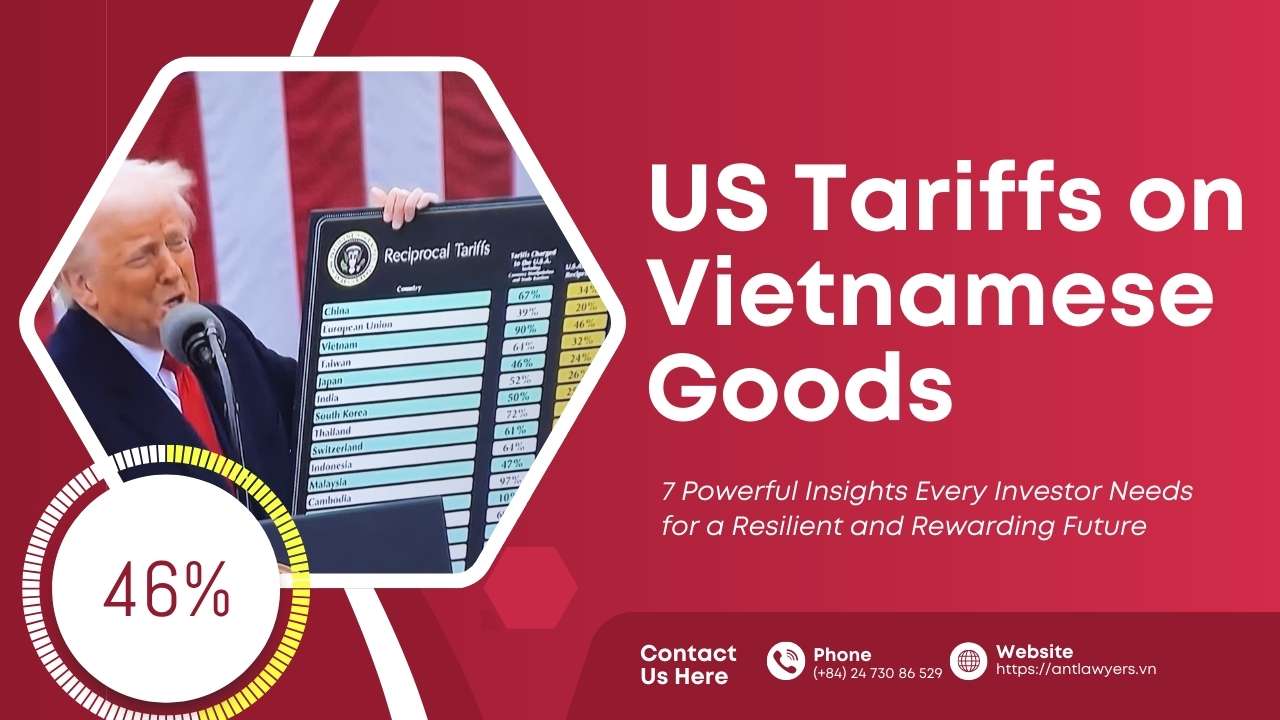
US Tariffs on Vietnamese Goods: 7 Powerful Insights Every Investor Needs for a Resilient and Rewarding Future

  The recent imposition of US tariffs on Vietnamese goods has stirred both caution and opportunity within Vietnam’s investment landscape. While surface level reactions may see this as a threat, seasoned investors recognize it as a pivotal moment, a time to reassess, realign, and reaffirm confidence in Vietnam’s long-term growth potential.

For foreign investors, those who have already invested or are considering entering and doing business in Vietnam, it is important to have a comprehensive, realistic, and forward-looking legal and strategic analysis.

We hope from here, together we will understand the regulatory context behind the US tariffs on Vietnamese goods, their actual and anticipated effects on supply chains, and the tactical steps investors can take to navigate the situation with clarity and advantage.

US Tariffs on Vietnamese Goods

Understanding the Policy Shift: Why the US Imposed Tariffs on Vietnamese Goods

On April 2, 2025, the United States announced a sweeping policy change, imposing new tariffs on Vietnamese goods, with some rates reaching up to 46%. The justification, as outlined in the White House fact sheet, revolves around concerns over economic sovereignty, trade deficits, and protection of domestic manufacturing.

These US tariffs on Vietnamese goods were not introduced in isolation. Rather, they were part of a broader initiative targeting several nations perceived to have “excessive and unfair trade advantages” with the United States.

The legal foundation was based on the International Emergency Economic Powers Act (IEEPA), which allows the US President to declare an economic emergency and impose trade-related restrictions, including tariffs.

For foreign investors in Vietnam, the move raised fundamental questions: Is Vietnam still a reliable production base? Will these tariffs reshape future export strategies? The answer lies not in reacting to uncertainty, but in understanding the rules and adapting to them strategically.

The Legal Landscape: How the US Tariffs on Vietnamese Goods Align with Law

The imposition of US tariffs on Vietnamese goods triggered debate in legal circles worldwide. Under WTO agreements, particularly the General Agreement on Tariffs and Trade (GATT) and the Agreement on Subsidies and Countervailing Measures, member countries are allowed to impose countervailing duties, but only after transparent investigations demonstrating evidence of subsidization and harm.

In the current case, many observers argue that the United States acted without the usual notice-and-comment periods or bilateral consultations. Vietnam, as a WTO member, has the right to seek consultations and, if necessary, pursue dispute resolution through the WTO Dispute Settlement Body.

From an investor’s point of view, the key legal takeaway is this: the tariffs may face formal legal challenge, and their permanence is far from guaranteed. However, in the short term, their economic effect must be accounted for in all operational and strategic plans.

Supply Chain Exposure: Identifying the Real Risk to Your Investments

Whether you’ve invested in manufacturing, logistics, or sourcing platforms in Vietnam, the new US tariffs on Vietnamese goods require a careful re-evaluation of exposure.

Key sectors most affected include:

  • Furniture and wood products
  • Apparel and footwear
  • Seafood and agricultural commodities
  • Consumer electronics and components

If your production is destined primarily for the US market, then tariffs of this scale could erode margins, delay shipments, or even lead to order cancellations. It is important to have a clear picture of their risk exposure to begin to find solutions.

Start with a tariff impact map: assess which products are affected, at what rates, and whether there are possible reclassification options.

Engage legal counsel familiar with customs law in both Vietnam and the US.

Contractual Risk: Are Your Agreements Shielding You or Exposing You?

One of the most underestimated consequences of US tariffs on Vietnamese goods is the impact on existing commercial agreements. Foreign investors often structure long-term contracts between Vietnamese subsidiaries and buyers in the US. These contracts may fix prices, delivery schedules, and tax responsibilities, yet few consider a scenario where external tariffs spike suddenly by over 40%.

Legal audits of all export-related contracts are now essential. Questions to ask:

  • Does your contract fix sale prices regardless of external duties?
  • Are there force majeure clauses that cover government-imposed tariffs?
  • Is there a mechanism for renegotiation in the case of regulatory changes?

Forward-thinking investors are already incorporating “tariff flexibility clauses” into new contracts. These provisions allow parties to revisit prices or terminate without penalty if geopolitical or regulatory events drastically change the cost structure.

Navigating the Short-Term:

In response to the US tariffs on Vietnamese goods, the investors would consider taking proactive steps such as:

  • Diversifying export markets: Leveraging Vietnam’s participation in a mumber of Free Trade Agreements, including the EU-Vietnam FTA (EVFTA), CPTPP, and RCEP, to shift focus to Europe, Japan, and regional ASEAN countries.
  • Engaging in origin engineering: Rethinking production layouts to legally alter the country of origin for finished goods.
  • Engaging with Vietnamese government trade facilitation programs: Several agencies have launched assistance initiatives for exporters impacted by the US tariffs.
  • Investing in product innovation: Products with strong IP protections or unique market appeal are often less price-sensitive and more resistant to tariff pressure.

Vietnam’s fundamentals remain strong: stable politics, a young and skilled workforce, and a proven record in infrastructure for manufacturing and logistics.

Will These US Tariffs on Vietnamese Goods Last? 

The future of the US tariffs on Vietnamese goods is uncertain. On the one hand, they stem from an executive order and may be rolled back or modified by a future administration or through successful WTO litigation. On the other hand, global trends toward deglobalization and economic nationalism suggest that such measures may become more frequent.

Legally, Vietnam has already initiated preliminary discussions with the US via established dialogue mechanisms, including the US-Vietnam Trade and Investment Framework Agreement (TIFA). If consultations fail, WTO action is likely. Investors should monitor these legal channels closely, not only to forecast future tariff policies but to understand when and how to adjust their operations.

Investment Opportunities Despite US Tariffs on Vietnamese Goods

It’s essential to emphasize that US tariffs on Vietnamese goods, but Vietnam is still considered a top-tier investment destination.

In fact, in many ways, Vietnam is better positioned than peers due to several enduring advantages:

  • FTAs continue to provide low- or zero-tariff access to over 50 countries, including some of the largest economies in the world.
  • Vietnam’s cost competitiveness remains high, especially compared to rising labor costs in China and growing instability in other parts of Asia.
  • Strong government support for FDI and legal reform (particularly in administrative procedures, IP protection, and dispute resolution) signals a maturing investment environment.

For foreign investors with a medium- to long-term horizon, ones with positive mind would take this event as it is and find solutions to adapt.

What Investors Should Do Next

Based on our analysis of the US tariffs on Vietnamese goods, foreign investors would consider the following steps:

  1. Conduct a tariff exposure audit across your product portfolio.
  2. Review all export-related contracts to identify risks and gaps.
  3. Engage in direct dialogue with trade associations and Vietnamese government authorities to stay informed.
  4. Explore market diversification with new customers outside the US.
  5. Implement contract and compliance.
  6. Invest in legal capacity, both in-house and through external advisors, to navigate international trade law.
  7. Evaluate the viability of restructuring parts of the supply chain for origin control or value-added enhancements.
  8. Prepare internal communication strategies to manage expectations of global headquarters, clients, and stakeholders.
  9. Turning Trade Tensions into Strategic Opportunity

In every disruption lies opportunity. The emergence of US tariffs on Vietnamese goods is undeniably a test of resilience for both Vietnamese industries and their international investors. But it also represents a defining moment, one where proactive businesses can separate themselves from competitors through legal foresight, strategic agility, and operational excellence.

Vietnam is not a passive player in global trade, it is a dynamic, reforming, and increasingly influential economy. Its response to these tariffs, and the response of the investors who believe in it, will shape the next chapter of regional economic development.

About ANT Lawyers, a Law Firm in Vietnam

We help clients overcome cultural barriers and achieve their strategic and financial outcomes, while ensuring the best interest rate protection, risk mitigation and regulatory compliance. ANT lawyers has lawyers in Ho Chi Minh city, Hanoi,  and Danang, and will help customers in doing business in Vietnam.

Source: https://antlawyers.vn/update/us-tariffs-on-vietnamese-goods.html